Thursday, May 24, 2012

My New Book

I just finished my book about the Eigenharp.

With the advent of the Workbench tool in Eigenlabs version 2 software there is now a great way to explore the setups that configure the instrument visually.

While workbench is primarily a tool for creating setups, it can also provide deep insights into any existing setup.

One of the challenges for people who might be interested in an Eigenharp is that they are difficult to find in a retail setting and, even if you do, there is typically no knowledgable person to walk you through what the instrument is capable of.

My hope is that this free book will help in that regard.

Friday, March 9, 2012

Playing to the Moon

Playing to the Moon by mikemilton
Playing to the Moon, a photo by mikemilton on Flickr.

I'm a early riser and have taken to playing my Eigenharp in the dark.

This morning was cold so I lit a fire, moved the chair and as I was sitting noticed this reflection of the instrument in the window against the moonset

Wednesday, July 20, 2011

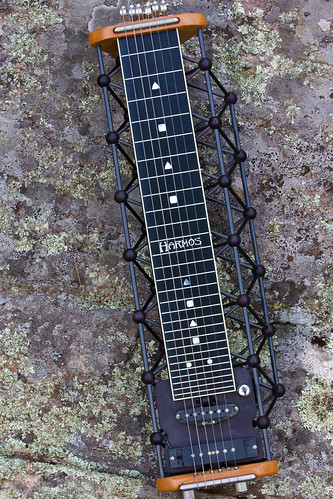
Harmos Guitar on the Rocks

Harmos Guitar on the Rocks by mikemilton
Harmos Guitar on the Rocks, a photo by mikemilton on Flickr.

I've been looking for one of these for quite a while and missed out on a sale of a 7-string version.

Patience pays, I guess, and this Americana 6 string has a new home.

It has an amazing ability to sustain and an interesting character to the sound (the resonant frequency of the guitar is quite high).

Friday, July 1, 2011

Thanks for the picks, Dave!


Dave got me a whole bag of these great picks. It took a month to arrive but, with the maple leaf it is perfect for today, Canada Day!

Saturday, June 25, 2011

Variability to Randomness

John Morley via Twitter: Comment from someone about DIY electronic instrument: "You never know what it is going to do"
I thought it was an interesting quote. I strongly believe in some degree of purpose in the instruments I use. I like to know what I am doing
Many traditional instruments have a degree of unavoidable variability in being played. Great players manage and even use this but it never disappears. Consider, for example, reed instruments, fretless string instruments and so forth. But it is not that the instrument is variable, it is that the interaction, the playing, is variable

In contrast, many electronic instruments are highly predictable and precise. Consider how round-robin application of multiple samples is often used to simulate the variability of the traditional instrument on a device that can be played in a completely repeatable way (many can *only* be repeatable)

There is one (well, probably more) key difference however. The player is part of the variability on the traditional instrument - the variability is nuance not randomness.


I believe that this leads to a profound tactile involvement between the player and the instrument that leads to expressiveness that is otherwise unattainable.

This point emerges from the discussion in the video to the right as well.


Tuesday, May 24, 2011

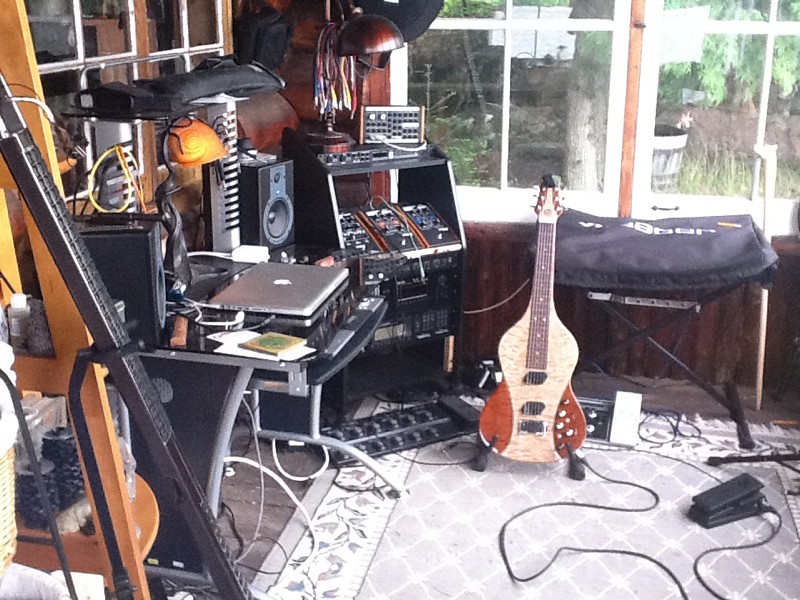
Summer Studio

Also known as the porch at the log cabin


- Posted using BlogPress from my iPad

Wednesday, May 4, 2011

A Tale of Two Capos

One challenge of some tunings is that they create more tension than desirable and one solution to this is to use a capo.  I described using a Shubb capo on a round neck Republic in an earlier post but have a similar issue on the Moog Lap Steel because, I'm told, its piezo pickups will not withstand tuning to GBDGBD.

Also, Shubb does not make a capo suitable for a squareneck or accommodating of the high string height of the MLS. So, I thought I'd try the Beard capos out.

There are two models to choose from so it seemed worth having a look at them both.

They come packaged in a bit of plastic tubing and arrived quickly.


Both work similarly. They have metal bar that is coated with a soft material which can be loosened in order to leave a gap between the body and the bar.

The bar is then inserted between the strings, the capo is rotated 90 degrees so that it crosses the strings and then the bar is tightened so that the capo is secured and the strings are in firm contact with the body of the capo.

The capo 'floats' on the strings and hence neck thickness and string heights are not an issue except that the action must be high enough to accomodate the bar under the strings.

Here is a shot of the brass version mounted in the strings.

It is exceptionally well made and finished.  This version has both a nut replacement and additional damping material. The nut material is firmly fastened to the body

From below you can see how the additional soft material intended to dampen the strings above the body works.


The other capo is a simpler, much more elegant, but missing both the nut material and the dampening of the strings behind the capo


Here is what they look like from the front:


Both are easy to attach and adjust although the 'well' in the brass version is less pronounced and the strings do not catch in it. Their appearance might appeal more or less, but that is an individual choice and each will have their own following.

So, do they sound different?

The strings above the capo vibrate with both capos. This seems to be a factor with any floating capo but it does not seem to affect the sound.

The nut material on the brass capo yields a sound more like the guitars nut while the metal one seem slightly brighter (which may be preferable)

The metal capo is prone to rattle on the top (thinner gauge) strings unless it is (very) firmly tightened. That said, it has a much larger tension knob allowing for this. I can't help but wonder dampening material similar to the brass one might not help with this.

On the MLS, sustain is not an issue but the steel one seems to have better sustain on my Republic and Dobro guitars.

My Take:

  • the steel one looks better to me
  • the sound of the brass one is preferable for my use
  • the level of tightening required by the steel one might cause wear to the soft material sooner
If I were buying just one for the MSL, I'd pick the brass one. If I were buying just one for playing blues on a metal bodied reso, I'd buy the steel one. Both will get use in my kit.

Wishlist....  I wish the steel one had similar dampening material on the underside.